Arcade Adventures at the Great Canadian Midway
The Great Canadian Midway on Clifton Hill in Niagara Falls is the largest indoor arcade in North America: ~70,000 square feet, more than 350 active machines, the longest unbroken commercial run of any arcade on the continent. A reading of how the quarter-eater format actually survived the 1990s home-console collapse — and why Canadian arcade culture became its strongest surviving form.
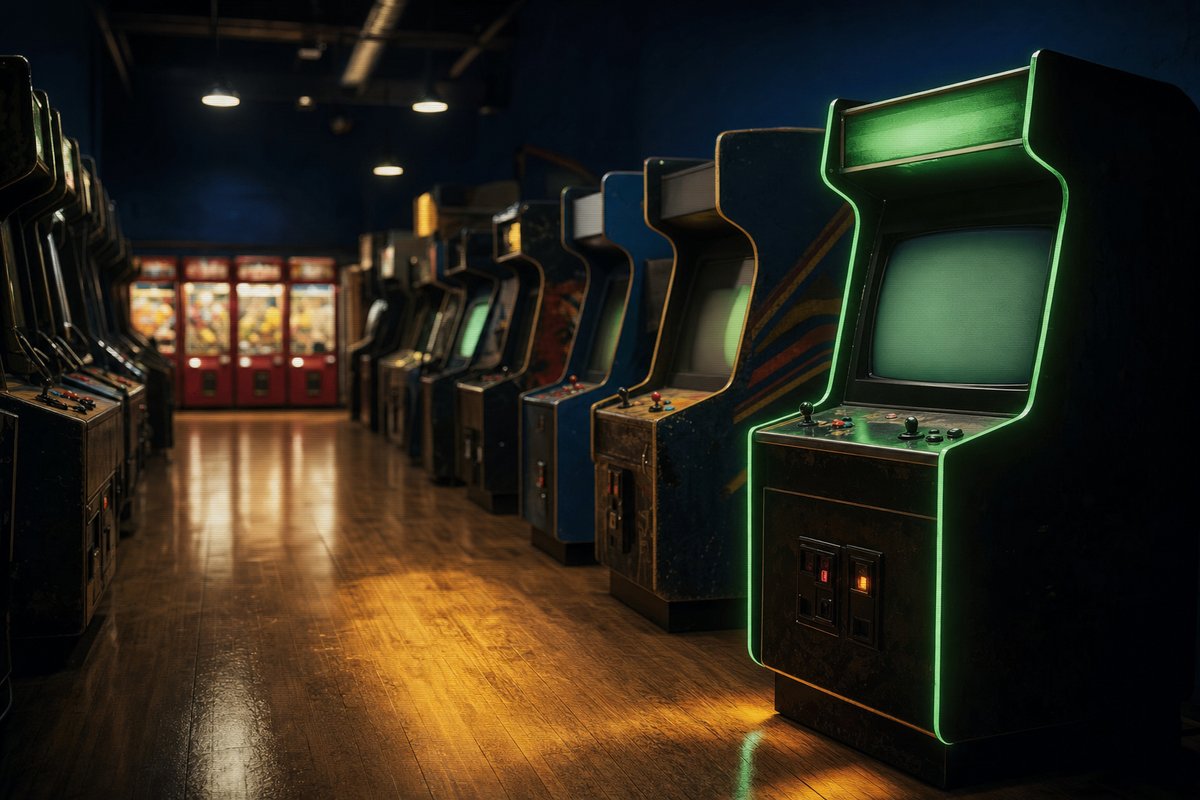
The conventional history of the arcade has the format dying twice. The first death was the 1983 crash that wiped out the early-1980s North American video-game market and took most arcades with it. The second was the long bleed-out of the mid-1990s and early 2000s, when the home consoles became powerful enough to host the games arcades depended on — Mortal Kombat, Street Fighter II, NBA Jam, the light-gun shooters, the racing simulators — and the quarter-eater business model collapsed without the technology gap that had sustained it.
That history is mostly accurate for the United States. It is not accurate for Canada. North of the border, a small set of operators kept the format alive through the collapse, and the largest of them — the Great Canadian Midway on Clifton Hill in Niagara Falls — is currently the biggest indoor arcade on the continent, operating roughly 70,000 square feet of floor space and more than 350 active machines.
The Midway is not a museum. It is a working commercial arcade with redemption-style prize counters, a working coin-pusher floor, and a curated catalog of recent racing and light-gun cabinets. The reason it matters to a reading of arcade culture is that it is the one survivor that has remained continuously in the original business — not a barcade, not a retro-revival, not a vintage-arcade museum — through the entire period that erased the rest of the format.
Why Clifton Hill
The Midway's location is the cleanest single explanation for its survival. Clifton Hill is the entertainment strip directly above the Falls. Foot traffic past the Midway's entrance averaged ~14 million annual visitors at peak tourist seasons through the mid-2010s, and the population mix — international tourists, school trips, weekend families — is exactly the audience an arcade needs and a barcade does not serve. The arcade is, in effect, a tourist-infrastructure asset, not a games-industry asset.
That distinction matters. American arcades that survived the 1990s collapse tended to do so by transitioning into either (a) family entertainment centers with mini-golf and laser tag bolted on, or (b) Dave & Buster's-style adult venues where the games are loss-leaders for the bar. The Midway did neither. It stayed an arcade — coin operation, redemption counter, the original quarter-eater contract — and used its location to bypass the question of whether arcades could compete with home consoles. Tourists at the Falls were never the audience that would have stayed home for a console anyway.
What the Floor Actually Holds
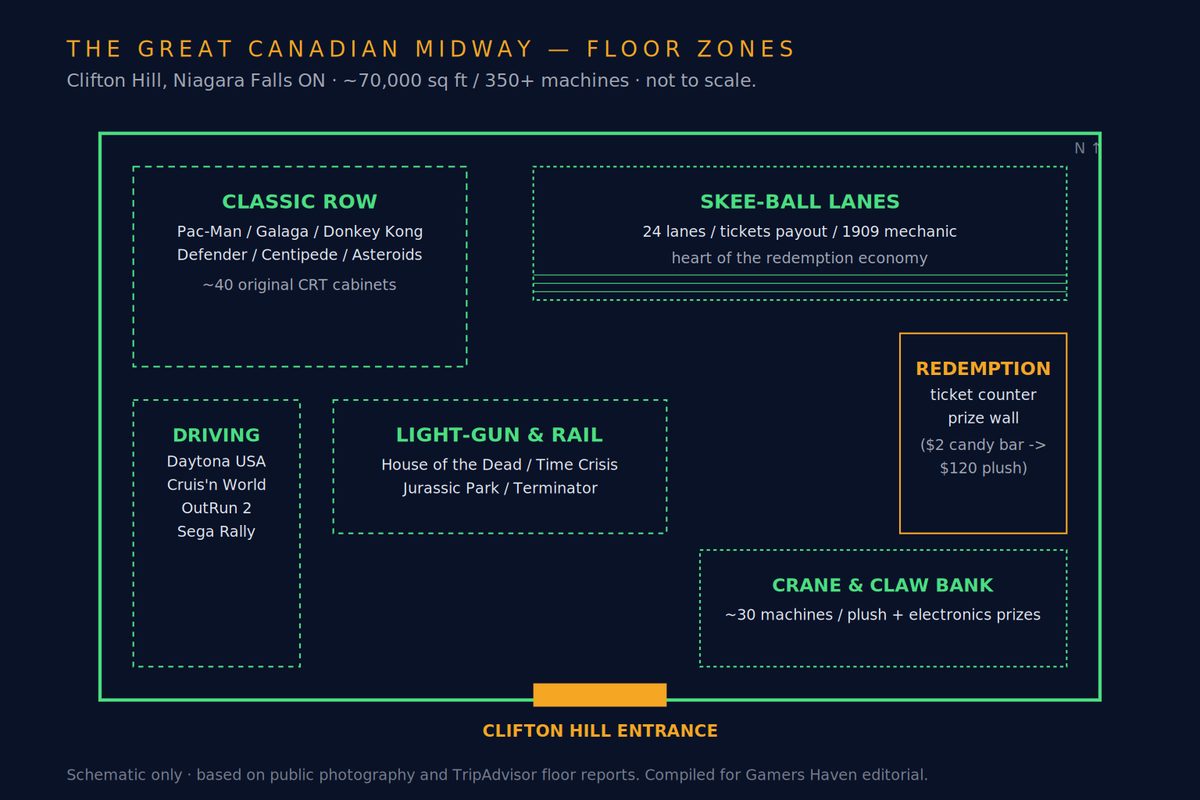
The Midway's catalog is curated rather than archival. The vintage cabinet population is small — a few Galaga cabinets, a Pac-Man, the occasional Tetris, scattered. The bulk of the floor is recent commercial machines designed for the arcade-specific market that has continued to exist outside the home-console competition:
- Racing simulators. Sit-down cabinets with proper hydraulic feedback, three-screen wraparound displays, and lap-time leaderboards. Mario Kart Arcade GP DX, Daytona Championship USA, Fast & Furious: Super Cars — these are not home games and have no consumer console release.
- Light-gun shooters. House of the Dead Scarlet Dawn, Aliens Armageddon, Time Crisis 5. The arcade light-gun format has continued to evolve technically (laser-based positioning, recoil feedback, calibrated optical sensors) in ways that home gun peripherals never matched.
- Music and rhythm cabinets. Dance Dance Revolution A and A20, Sound Voltex, Beatmania IIDX, the various Maimai and Chunithm cabinets when they get a North American import run. The rhythm-arcade format is the strongest single survival case for the format: home releases of DDR never matched the cabinet experience, and the East Asian rhythm-arcade catalog continues to produce new machines aimed specifically at this venue type.
- Redemption-floor machines. The ticket-based prize-redemption section is the largest single floor area. Skee-Ball, coin pushers, the various Cyclone spinning-jackpot machines, Big Bass Wheel, Down the Clown. These are the format's working economic engine: every machine is calibrated to a known house-edge ratio, and the redemption floor cross-subsidizes the simulator floor that operates at lower margin.
- Networked cabinets. Capcom's Street Fighter V Champion Edition network kiosks, Sega's Initial D Arcade Stage Zero with its card-based player accounts. The networked-cabinet model — players carry their progression on a physical RFID card from one arcade to another — is alive only in the surviving operator population.
Notably absent: the home-console ports. The Midway has no Xbox stations, no PlayStation demos, no PC kiosks. The discipline is enforced by economics — a home-console kiosk does not earn its floor area in coin drop — but the result reads as a kind of curatorial honesty. The Midway is an arcade specifically, not a "games space" generally.
Why the Quarter-Eater Format Still Works
The economics of the surviving arcade catalog are different from the 1980s ones. A modern racing cabinet costs the operator $30,000-$60,000 new and typically pays back within 18-24 months on a high-traffic floor. The cabinet's value is not the game itself (which is often technically inferior to a home racing title) but the experience scaffold around it — the seat, the wheel, the wraparound display, the three-cabinet leaderboard. A home console cannot replicate the experience, and home VR has not closed the gap either, because the cabinet's value is partly social: leaderboards, side-by-side competition, the small ritual of the actual coin drop.
This is the same reasoning that keeps niche surviving formats — pinball, bowling, ten-pin alleys — alive. The arcade is a venue category, not a games category. Once the format is read that way, the question "did arcades die?" becomes "did the venue type collapse?", and the answer for Canadian tourist-corridor venues is: no.
Why Canada Was Different
Three factors made the Canadian survival arc different from the American one.
The first is geography. Canada's tourist economy is more concentrated than the American one — Niagara Falls, the Quebec corridor (Montreal/Quebec City), Banff, Vancouver — and the surviving arcades cluster on those routes. Clifton Hill, Old Quebec, and the Granville Island/PNE corridor in Vancouver each support venues that would not be commercially viable in non-tourist American small cities.
The second is cross-border dollar economics. Canadian arcades have historically operated at a price point set in Canadian dollars while drawing American customers paying in U.S. dollars. The exchange-rate gap (CAD trading at $0.70-0.85 USD through most of the post-2010 period) effectively subsidizes the cabinets, since the operator's costs are CAD-denominated while the customer's spending capacity is USD-denominated. The Midway is a beneficiary of this; American family-entertainment operators in border states had no such advantage.
The third is the cultural valence. The arcade-going habit in Canada was less aggressively coded as nostalgic than in the American market. American arcades that survived the collapse mostly did so by leaning into the retro-arcade aesthetic — neon signs, CRT cabinets, 1980s curation. Canadian arcades, particularly the Niagara and Quebec venues, never fully made that pivot; they remained working commercial spaces with contemporary catalogs. The "Canadian arcade" is, in 2025, simply an arcade — the format that the American category had to rebrand to survive.
Adjacent Surviving Forms
The Midway is not entirely alone. A small set of North American venues holds enough scale to count as continuous commercial operations rather than retro revivals:
- Round 1 USA — the American expansion of the Japanese Round 1 Entertainment chain, which imports East Asian arcade catalog (rhythm games, music cabinets, networked fighting) into mall-anchor locations. Currently operating ~50 venues across the United States; the Midway is roughly the equivalent format on a smaller-but-denser footprint.
- Funspot in Weirs Beach, New Hampshire — by floor area the closest American analog to the Midway, with a heavier vintage-cabinet tilt. Funspot is a legacy operator (founded 1952) that has consciously preserved vintage cabinets while keeping its commercial floor running.
- Akihabara-class — Japan's arcade catalog continues to function as the global benchmark. Taito Station, Round 1 (the original Japanese chain), Sega's surviving venues, and the regional independents. Most surviving North American arcade catalog can be traced to a Japanese cabinet vendor.
The category that has grown most rapidly since 2015 is the barcade — venues that combine a small curated arcade floor with a working bar (Barcade in Brooklyn, Coin-Op Game Room in San Francisco, the various Insert Coins in Vegas). These are distinct from the surviving working arcades in that the floor is curated for nostalgia and the economic anchor is alcohol sales, not cabinet revenue.
The Emulation Question
Any reading of arcade survival has to address the emulation question. The catalog that defined the 1980s arcade — Pac-Man, Galaga, Donkey Kong, Defender, Robotron 2084, Tempest, Centipede — is, in 2025, almost entirely available through emulation. MAME (Multiple Arcade Machine Emulator), now in continuous development for nearly thirty years, runs essentially the entire pre-3D arcade catalog. The legal status of the ROMs varies, but the technical preservation question is effectively solved.
Emulation is the reason vintage cabinets are not the survival mechanism for the format. The vintage catalog is fully accessible at near-zero cost to anyone with a Raspberry Pi and a USB joystick. The Midway's catalog choice — to skip the vintage curation and lean into the contemporary cabinets that cannot be home-emulated — is the rational response. Where home access is fully available, no commercial venue can compete on the same catalog. Where it is not, the commercial venue still has a market.
This is also the reason barcades and retro-arcade museums lean on their atmosphere and curation rather than their catalog. The catalog has been free for fifteen years. What is being sold is the venue.
What the Survival Says
The Great Canadian Midway is a working test of a thesis about the medium: that platform formats are not killed by their technical successors so much as displaced from their original niche. The home console did not kill the arcade; it killed the arcade's function as the technically superior place to play games. The function the format actually delivered — a venue, a social ritual, a physical-input experience that does not translate to the living room — survived in the venues that understood themselves as serving that function rather than as competing on catalog.
The same pattern shows up across the medium. The mainline Half-Life chronology survived by becoming a VR-specific format with Alyx — Valve's response to the question of where to take the franchise was to find the technical niche where the original game's value (immersive, linear, environmentally rich first-person) still had no substitute. The Zelda series survived by treating the "continuity" question as decorative and the open-world traversal mechanics as the actual product. The arcade survived by accepting that the catalog was no longer the value proposition and that the venue type was. In each case the answer is the same: the format moves to the niche where it still has irreplaceable value, and the rest of it gets remembered rather than continued.
That, more than the cabinet rotation or the redemption-counter economy, is what Clifton Hill demonstrates. The largest indoor arcade in North America is the size it is not because it is preserving the 1982 format, but because it is running the 2025 version of an arcade — one that has shed almost every part of the original business that the home console could replace, and kept the parts that the home console still can't.
Frequently Asked Questions
Where is the Great Canadian Midway?
4950 Clifton Hill, Niagara Falls, Ontario, Canada. Clifton Hill is the entertainment strip immediately above the Falls. The Midway is the anchor venue on the south side of the hill and operates as part of the larger HOCO Entertainment & Resorts portfolio of Clifton Hill attractions.
How big is the Great Canadian Midway?
Approximately 70,000 square feet of indoor floor area, holding more than 350 active machines across racing simulators, light-gun shooters, music and rhythm cabinets, networked fighting kiosks, and the redemption floor. It is the largest indoor commercial arcade in North America by floor area and by active machine count.
When did the Great Canadian Midway open?
The original Clifton Hill amusement operations on the site date to the 1960s. The "Great Canadian Midway" branding and the current floor configuration consolidated through the 1990s under HOCO ownership. The venue has been continuously commercially operated under the Midway brand since approximately 1995.
Is the Midway a vintage-cabinet arcade?
No. The Midway carries a small number of vintage cabinets but the catalog is overwhelmingly contemporary commercial machines — recent racing simulators, light-gun shooters, music and rhythm cabinets, networked fighting kiosks. The curation focuses on cabinets that cannot be replicated at home, not on cabinets that are notable for their age.
What does it cost to play at the Midway?
The Midway uses a pre-paid arcade card rather than coins. Cards are loaded at kiosks; individual machines deduct credits per play (typically 5-30 credits per session depending on the cabinet). Day passes and group rates are offered seasonally. Pricing is set in Canadian dollars and is roughly comparable to a coin-operated equivalent.
Further Reading on Gamers Haven
- Konami's Decline — Konami's pachinko pivot is the inverse story: a publisher that abandoned its console catalog for venue-based gaming.
- Don't Wait for Half-Life 3 — how Valve chose VR rather than a sequel as the answer to the same "where does the format go next" question.
- Random Encounters in RPGs — another design idea that survived in one niche after the mainstream walked away.
- The Zelda Timeline Still Makes No Sense — a parallel reading on what survives when an old format gets a forced retrofit.