Coverage of Valve's Half-Life franchise — the sequel that did not arrive, the VR step-release that did, and the structural relationship between a publisher's patience and an audience's anticipation.
Half-Life is the medium's longest-running unresolved canonical question. Gamers Haven covers it as a publisher-strategy story rather than a missing-sequel story.
1998
Half-Life 1 shipped
Black Mesa, Gordon Freeman, the resonance cascade
13
Year gap
from Episode Two (2007) to Half-Life: Alyx (2020)
0
Entries titled "3"
Valve has not announced and will not ship Half-Life 3
Half-Life 2 shipped in 2004. Episode Two ended on a cliffhanger in 2007. Two decades later, Valve has shipped neither Half-Life 3 nor Episode Three. The reading: “Valve will not finish the franchise the way fans want” is not a missing-sequel problem — it is a business choice, and Half-Life: Alyx (2020) was Valve's actual answer.
2015/10/15 · 15 min read
Featured visual
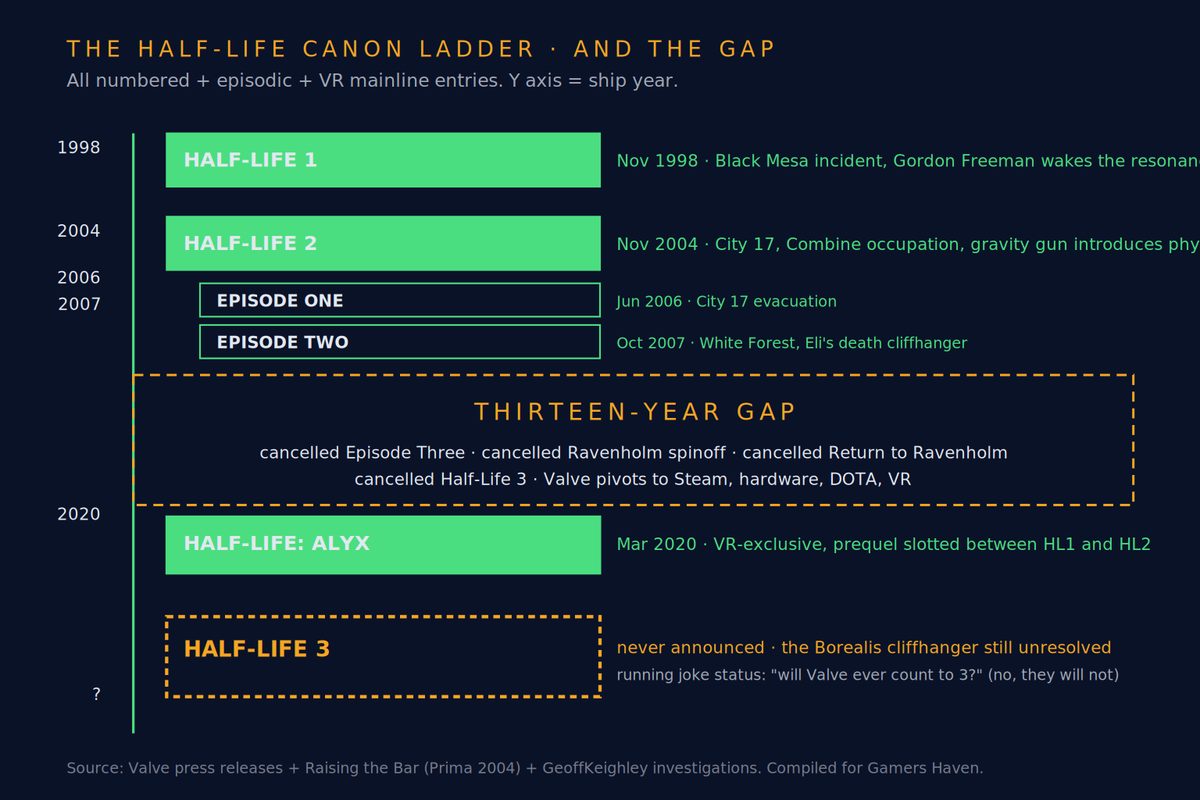
A thirteen-year gap with one VR entry inside it.
Every shipped Half-Life mainline entry from 1998 to 2020 plotted against ship year — the original through Episode Two, the thirteen-year gap that swallowed three cancelled projects, Alyx as the answer Valve actually shipped, and the dangling Half-Life 3 rung that has not arrived.
The Half-Life beat is the part of Gamers Haven editorial that reads Valve as a publisher rather than as a games studio. The medium has spent two decades asking when Half-Life 3 will arrive, and the more interesting question — the one this category covers — is why Valve has chosen not to ship it. The answer is structural: Valve's actual business is the Steam platform, the franchise's value is preserved by allocating it to generational steps rather than annual sequels, and the company's flat-management organizational structure makes large schedule-driven projects unusually hard to execute. Half-Life: Alyx (2020) was the answer to all three constraints — a VR-first entry small enough to ship, large enough to count as a generational step, and important enough to canonically reset the post-Episode Two cliffhanger.
The longer reading lives in the full feature. The category landing is intentionally a single-entry hub for now. Adjacent coverage on the broader Gamers Haven editorial — the Konami catalog story, the Zelda timeline retrofit, the UbiVerse continuity puzzle — sits alongside this beat because all four are different answers to the same publisher question: what does a franchise owe its audience, and what does it cost the publisher to deliver that. The Half-Life beat will grow with future entries on Portal's place in the Aperture canon, the Steam Deck's effect on Valve's release calendar, and the broader VR-platform question Valve has been quietly answering for a decade.
Quick Questions
Category FAQ
Is Half-Life 3 coming?
Almost certainly not in the conventional flat-screen sequel form. Valve has not announced it, has not signalled it in any leak, and has not allocated senior engineering effort to it. Half-Life: Alyx (2020) was Valve's actual answer to "where does the franchise go next" — a VR-exclusive, step-release entry rather than a numbered sequel.
What did Half-Life: Alyx do for the franchise?
It reset the canon. The closing scene of Alyx retroactively overwrites the cliffhanger ending of Episode Two (2007) and positions the Borealis subplot for a future entry. In effect, Alyx is the canonical sequel to Episode Two in everything but title.
What is Marc Laidlaw's Epistle 3?
A thinly-veiled summary of what would have been Episode Three's plot, published in August 2017 on Marc Laidlaw's personal site after he left Valve in 2016. Character names are slightly altered but the events are recognisable. It functioned as a release valve for the community waiting for the cancelled game.
Why has Valve not made Half-Life 3?
Three reasons. The financial math (Steam's platform revenue dwarfs any single first-party game release); the creative requirement that the franchise only ships when a new generational step is possible (VR was that step in 2020); and Valve's flat-management organizational structure, which makes large schedule-driven projects structurally hard to execute.
Does Gamers Haven cover the Portal series too?
Adjacent. Portal and Half-Life share the Aperture Science setting and are canonically connected. Future Half-Life category coverage on Gamers Haven will likely include Portal readings where they intersect with the broader franchise discussion.