Random Encounters in RPGs
The mechanic that defined a generation of JRPGs has been quietly retired by the genre that invented it. A short reading of how random encounters evolved — and what they were always actually for.
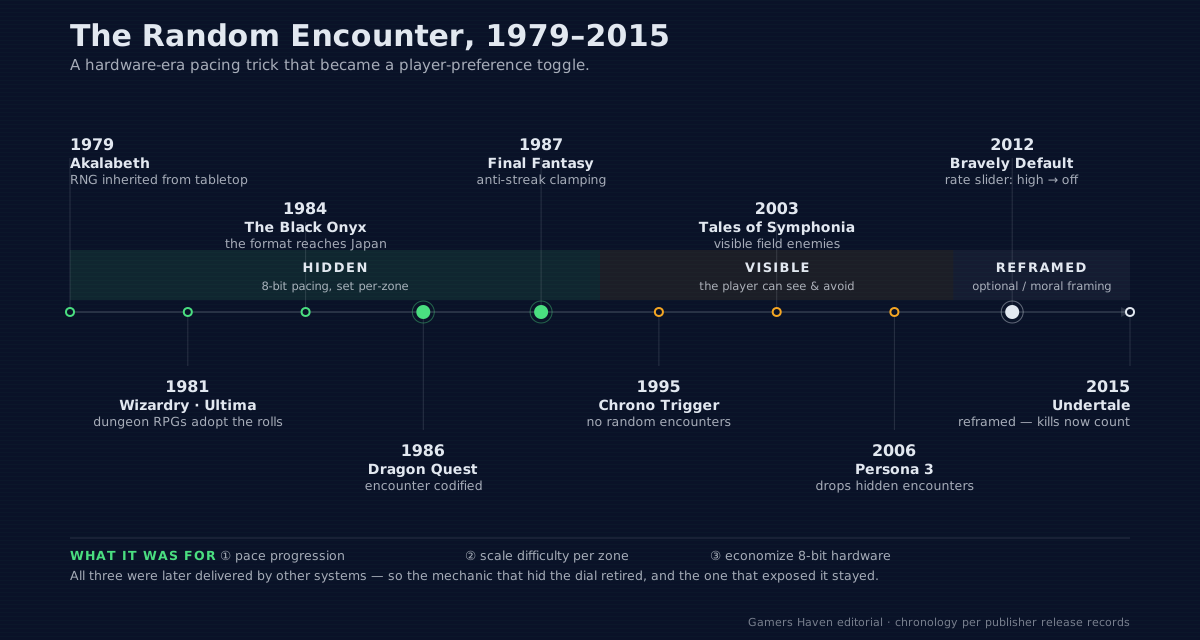
Randomness has been part of games since games existed. Tabletop roleplaying — Dungeons & Dragons, Traveller, RuneQuest — built its entire combat resolution on dice rolls, and the videogame RPGs that emerged in the late 1970s and early 1980s inherited the random-number-generator habit without much argument. Akalabeth (1979), Wizardry (1981), Ultima (1981), The Black Onyx (1984), and then Dragon Quest (1986) and Final Fantasy (1987) — by the mid-1980s, the JRPG genre had codified a particular use of randomness that would shape the next thirty years of design: the random encounter.
A random encounter is, mechanically, the simplest possible thing. As the player moves through a dungeon or overworld, a hidden counter ticks down with each step. When the counter hits zero, an enemy formation rolls from a location-specific encounter table and combat begins. The player has no warning, no agency over whether the encounter triggers, and no ability to see the enemy approaching. The whole point of the mechanic is that the world is dangerous and the danger is unpredictable.
The mechanic was solving a specific 1980s problem. JRPG dungeons were small (a few screens), and turn-based combat could only be deployed inside a separate combat screen. Showing the enemy on the dungeon map would have required either real-time chase AI (computationally expensive on 8-bit hardware) or visible enemy sprites that broke the dungeon's spatial atmosphere. The random-encounter format solved both problems: dungeons stayed quiet and atmospheric; combat happened in a dedicated screen with its own visual budget; and the player's grinding behavior could be regulated by the encounter rate.
Dragon Quest's Algorithm
Dragon Quest (1986) is generally credited as the originator. The encounter system in the first Dragon Quest was deliberately constrained: encounter probability scaled with terrain (forests denser than plains, dungeons denser than overworld), and the table of possible enemies was narrowed by the player's current location. Final Fantasy (1987) added one refinement that would matter more than the rest: a guard against very-short and very-long encounter intervals. The 1987 algorithm rolled a check on every step, but adjusted the probability downward in the few steps after a previous encounter (to prevent two encounters in a row) and upward as the no-encounter streak extended (to prevent ten minutes of walking with no combat). That clamping was the trick that made the system feel paced rather than purely stochastic.
The 8-bit-era games hid all of this from the player. The encounter rate was a tunable that designers set per-zone, and the player experienced it as ambient pacing. That opacity was the system's strength — and, eventually, the reason the genre had to walk away from it.
Tales of Symphonia and Visible Enemies
Tales of Symphonia (2003) was one of the loudest single-game retirements of the random-encounter format. The Tales series had always used field-encounter sprites — enemies visible on the overworld and dungeon map — but Symphonia, as the first 3D Tales, made the visibility a design statement. Monsters walked around. The player could see them coming. Combat triggered only on contact. Strategic avoidance became a real possibility.
The same generation of JRPGs (the late-PS2, early-PS3 era) made the same switch. The Persona series adopted visible enemies from Persona 3 (2006); Chrono Trigger's no-random-encounters approach (1995, ahead of its time) was retrospectively cited as the inspiration; the entire mid-2000s JRPG generation effectively concluded that hiding the enemy from the player was no longer worth the design trade-off. By 2010, the random-encounter format was a minority position in published RPGs.
Bravely Default and the Slider
Bravely Default (Square Enix, 2012; Western release 2014) made the most explicit possible statement on the question. The game's options menu contains a slider for encounter rate, labelled from "very high" through "default" to "off". The player chooses, mid-game, whether to grind, focus on story, or skip combat entirely.
The honest reading of Bravely Default's slider is that Square Enix had concluded the random-encounter rate was a player-preference parameter rather than a designed pacing element. The game's combat system was strong enough to stand on its own merits; the random-encounter format was no longer required to deliver it. Letting the player set the dial was the natural conclusion. Subsequent Bravely entries kept the slider; so did Octopath Traveler and several adjacent Square Enix releases. The mechanic that Dragon Quest and Final Fantasy had hidden from the player in the 1980s was now a user-configurable preference.
Undertale and the Ethics Layer
Undertale (Toby Fox, 2015) added the unexpected reading. Undertale uses the random-encounter format — the player walks through the Underground and combat triggers without warning — but layers a moral framework on top of it. Every enemy can be befriended or killed. Killing earns experience and gold; befriending does not. The player who grinds — who kills every enemy in every encounter — gradually depopulates the game's world, and the game knows. The "Genocide route" of Undertale is what happens when a player applies the standard JRPG grinding behavior to a world that is internally aware of it.
This was a kind of structural critique of the random-encounter format. The format had always treated the enemies as procedurally-regenerated obstacles whose deaths had no in-fiction consequence — they would respawn next time. Undertale pointed out that this assumption was a designer's convenience, not a fact about the world, and rewrote the format so that the deaths counted. The resulting Genocide route became the game's most-discussed structural element.
What the Random Encounter Was Always For
The mechanic served three functions in the 1980s. It paced the player's progression by forcing combat exposure. It scaled the difficulty curve through the location-specific encounter tables. And it economized the hardware budget by separating overworld traversal from combat rendering.
Each of those functions has been displaced by a different mechanic in the 2010-2025 generation. Pacing is delivered by quest-driven structure rather than ambient combat. Difficulty curves are scaled through level-gated regions and visible enemy threat-ratings. The hardware-budget concern is gone entirely — modern engines can render combat and traversal in the same scene without separation. The format that the random encounter served has been refactored around it.
What remains is the player-preference question, which is what Bravely Default's slider acknowledged. Some players want the ambient grind; others want the story; the format that hid the dial from the player was the one that had to retire. The format that exposes the dial is the one that has continued, in selective form, into the modern generation.
The longer reading is in the pieces on Nintendo's open-air pivot and Valve's platform-step strategy. The random encounter is a small example of a larger pattern: design ideas survive when the function they served still needs serving, and disappear when the function gets refactored. They do not disappear because the new generation thinks they were bad — they disappear because someone built a better way to do the same job.
Frequently Asked Questions
What is a random encounter?
In an RPG context, a random encounter is a combat event that triggers without warning as the player moves through a dungeon or overworld. A hidden counter ticks down with each step; when it hits zero, an enemy formation rolls from a location-specific table and combat begins. The format was standard in 1980s-1990s JRPGs and largely retired in the 2010s.
Who invented random encounters?
Dragon Quest (Yuji Horii / Enix, 1986) is generally credited. The mechanic has tabletop antecedents (random-encounter tables in D&D), but the specific videogame implementation of a per-step probability check with a hidden counter is the Dragon Quest contribution. Final Fantasy (1987) refined the algorithm.
Why did random encounters fall out of fashion?
Three reasons. (1) Hardware budgets allowed visible enemies on the same map as the player, removing the technical justification. (2) Player preference shifted toward agency-over-pacing rather than ambient pacing. (3) Story-focused RPGs needed combat to be a deliberate choice, not an ambient interruption.
Which RPGs still use random encounters?
Selectively: Octopath Traveler series, the Bravely series, several 3DS/Switch JRPGs (Etrian Odyssey, Shin Megami Tensei's mainline entries), most Dragon Quest entries through DQ XI. Most use a user-configurable encounter rate rather than a pure-hidden roll.
What is the Bravely Default slider?
A user-controllable slider in Bravely Default's (2012) options menu that lets the player set the random-encounter rate from "very high" down to "off". The slider was a significant moment in the genre's relationship with the mechanic because it explicitly handed control of the pacing to the player.
Does Undertale have random encounters?
Yes — most of the Underground uses the random-encounter format. The game's distinctive contribution is the moral layer added on top: every enemy can be spared rather than killed, and the cumulative consequences of the player's choices determine which ending the game leads to.
What is the Genocide route in Undertale?
The ending path that triggers when the player kills every available enemy in every region. The route is named for what it depicts: the player's grinding behavior depopulates the game's world. The Genocide route is structurally the most-discussed element of Undertale's design because it makes the consequences of standard JRPG grinding behavior in-fiction visible.
What is grinding?
In RPG terminology, grinding is the act of deliberately engaging in repetitive combat to gain experience points, currency, or item drops. The behavior is a function of the random-encounter format — when combat is ambient and respawning, the player can grind by simply walking in circles. Visible-enemy designs make grinding harder because each enemy must be approached deliberately.
Does Chrono Trigger use random encounters?
No. Chrono Trigger (1995) was one of the earliest mainstream JRPGs to skip the random-encounter format entirely. Enemies are visible on the map and combat triggers on contact. The design choice was widely cited in the mid-2000s when the genre began rethinking the format.
Are random encounters coming back?
No clear trend either way. Indie JRPGs (Sea of Stars, Octopath Traveler II) have adopted user-configurable encounter rates as the default. The mainstream JRPG generation is mostly settled on visible enemies. The selective survival is in the retro-tribute and indie segments, where the format is part of the deliberate genre callback rather than a design choice driven by hardware limits.
Further Reading on Gamers Haven
- The Zelda Timeline Still Makes No Sense — a much bigger version of "mechanic that refused to die".
- Don't Wait for Half-Life 3 — the patience economy in a different format.
- Arcade Adventures at the Great Canadian Midway — another design idea that survived in one niche.
- Artificial Intelligence and Minecraft — what happens when the world keeps regenerating beneath an agent.