Is Far Cry Primal Part of the UbiVerse?
Ubisoft has spent a decade quietly stitching Assassin's Creed, Far Cry and Watch_Dogs into a shared canon. Far Cry Primal, set ten thousand years before any other entry, is the cleanest test of whether that universe actually holds together — or whether the UbiVerse is just Easter eggs read by motivated fans.
Far Cry Primal released in February 2016 to a 76 Metacritic score and the second-largest opening-week sales in the franchise's history. The marketing positioned it as a tonal experiment — first-person Mesolithic survival, the Lakota-influenced "Wenja" tribe, a protagonist who tames sabre-toothed cats — but the more interesting question got less attention. Far Cry Primal is set roughly ten thousand years before the next-earliest mainline Ubisoft game. If the UbiVerse exists, where does this one fit?
The short answer is: somewhere, by way of a single thin thread. The longer answer is that the UbiVerse is the same kind of structure as the Zelda timeline — a continuity claim made after the fact, supported mostly by Easter eggs, and held together only by readers who want it to hold.
What the UbiVerse Actually Is
The UbiVerse is the unofficial name for the shared continuity that connects most modern Ubisoft action games. The connection runs primarily through two engines:
- The Animus framework. Introduced in the first Assassin's Creed (2007), the Animus is a fictional machine that lets a present-day operator relive the genetic memories of an ancestor. The series' present-day frame story features the corporation Abstergo Industries (the modern face of the Templar Order) running the Animus on captive subjects to extract historical intelligence.
- The First Civilization plot device. The Animus reveals that human history has been shaped by a precursor species — the Isu, sometimes called "Those Who Came Before" — whose artifacts (the Pieces of Eden) confer power over thought, vision, and matter. The First Civilization is the in-universe explanation for everything from the Library of Alexandria's location to recurring religious iconography across cultures.
The Animus and the First Civilization make Assassin's Creed a continuity engine that other Ubisoft franchises can plug into without serialising their narratives. The connecting tissue is then deployed through Easter eggs — Abstergo logos, Pieces of Eden, named characters appearing in the background of another game — that fans assemble into a single canon.
The Evidence for a Shared UbiVerse
The Easter-egg trail is dense but not exhaustive. A representative slice:
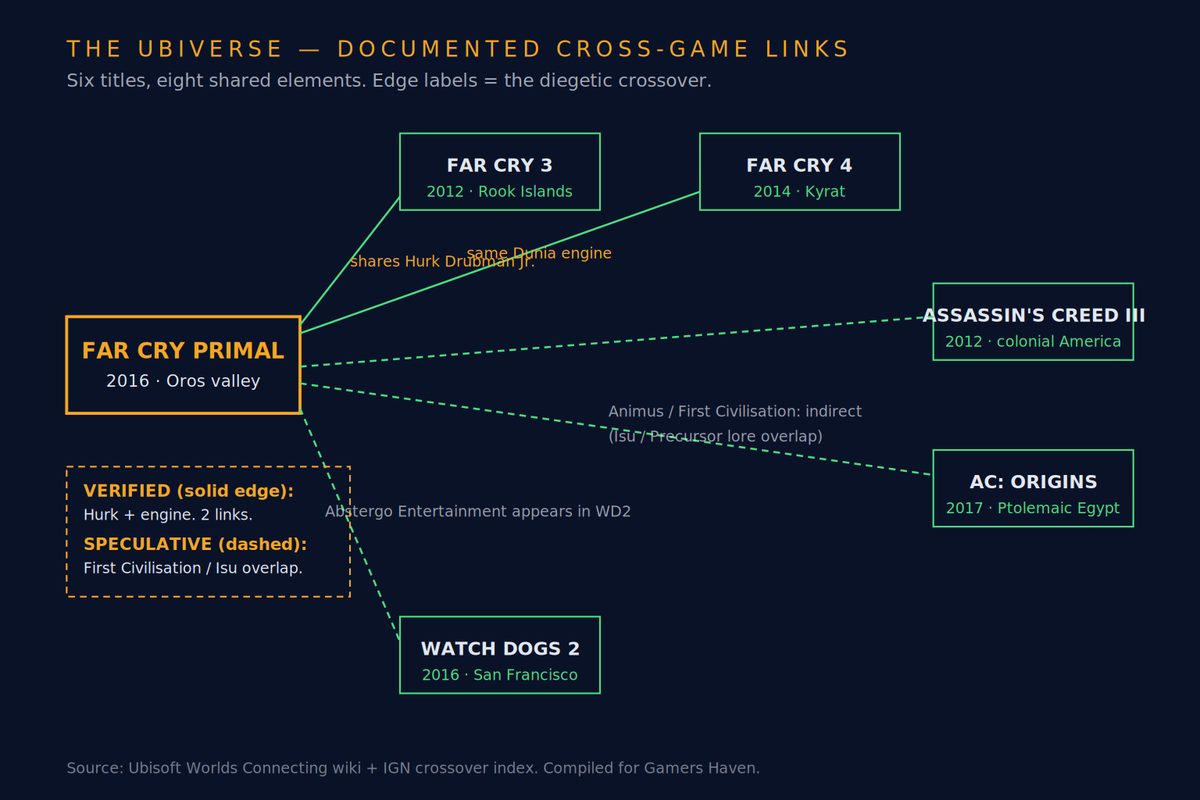
- Far Cry 3 (2012) contains an Abstergo Industries logo on a computer in Hoyt Volker's office. The game's antagonist also references a "research and development department" that maps to Abstergo's plausible front-company structure.
- Watch_Dogs (2014) features the CEO of Abstergo Entertainment, Olivier Garneau, who can be hacked by Aiden Pearce. Later Assassin's Creed Syndicate (2015) confirms that Garneau was assassinated by an Assassin operative — a literal cross-game causal link.
- Watch_Dogs 2 (2016) lets the player retrieve files identifying Abstergo as a Templar-aligned corporation, restating the shared-canon link explicitly.
- Assassin's Creed Origins (2017) and Odyssey (2018) feature the present-day Layla Hassan plotline, which sits inside the same Animus framework as the modern Watch_Dogs/Far Cry retrofit.
- The Far Cry franchise itself maintains internal continuity — Vaas (Far Cry 3) is referenced by Hoyt; Pagan Min (Far Cry 4) keeps a photograph and a piece of Vaas-era memorabilia in his throne room — and that internal continuity is the chain along which the UbiVerse threads.
Each of these is, on its own, a small and reasonable inclusion. Aggregated, they suggest a deliberate Ubisoft project to share continuity across action franchises. Aggregated harder, they suggest the kind of fan-supported retrofit that produced the Zelda timeline.
Where Primal Fits — Or Doesn't
The clean argument for Far Cry Primal's inclusion comes from the in-game Beastmaster ability. Takkar, the protagonist, can tame predator animals (sabre-toothed tiger, brown bear, dhole) and direct them in combat. This ability appears nowhere else in the Far Cry franchise — except in Far Cry 4 (2014), where Yuma Lau's elite enemies known as "Beastmasters" can summon and direct local predators in much the same way.
The popular reading is that Yuma's Beastmasters are Takkar's distant descendants, and that the Beastmaster ability is being passed down through the same genetic-memory mechanism the Animus exploits. If that reading holds, Far Cry Primal is canonically linked to Far Cry 4, and via Far Cry 4 to the rest of the UbiVerse.
The thinner version of the reading — and the one that actually fits the published evidence — is that Ubisoft Montréal's design team reused a mechanical idea (predator companion AI) across two consecutive game cycles and that the in-fiction explanation is incidental. Game Theory's 2016 video advanced the descendant theory, but Ubisoft has never confirmed it. The cleanest Occam reading is that the Beastmaster mechanic is a design carry, not a canonical lineage.
Strong and Weak Versions of the UbiVerse Claim
Two readings of the UbiVerse run side by side in the community, and they make very different claims.
The Strong Version
Every Ubisoft action game from Assassin's Creed I (2007) onward is on a single contiguous timeline. The Animus and the First Civilization explain everything that looks supernatural. Genetic memory is a real in-universe phenomenon, and inherited abilities (Eagle Vision in Assassin's Creed, the Beastmaster trait across the Far Cry lineage) propagate through bloodlines exactly the way the Animus stories say they do.
This is the reading that lets Far Cry Primal connect to the rest of the canon. It is also the reading that requires the most extra-textual scaffolding: most Ubisoft games never mention the Animus, never reference Abstergo on screen, and never depict First Civilization artifacts. The strong version is supported by a small number of dense Easter eggs and the implicit logic of genetic memory.
The Weak Version
Most Ubisoft games are independent fictions. A subset — Assassin's Creed, the present-day Watch_Dogs, the Watch_Dogs/Assassin's Creed crossover scene — share an explicit continuity. Other games (Far Cry 3, Far Cry 4, Far Cry Primal, Rainbow Six Siege) contain Easter eggs that imply but do not confirm shared canon.
Under the weak version, Far Cry Primal is at most a cousin to the UbiVerse. The Beastmaster lineage is a fan reading, not a Ubisoft statement. The Mesolithic setting is the most defensible single-game story in the franchise precisely because it does not need to be embedded in a longer continuity.
The weak version is the one that fits Ubisoft's public statements. The strong version is the one that fits the fan-curated wikis.
Why the UbiVerse Project Is Telling
Two things are interesting about the UbiVerse as a creative project, neither of which is the question of whether Far Cry Primal "really" fits.
The first is the way Ubisoft has cultivated the ambiguity. The Easter eggs are placed, never explained. Ubisoft Montréal's writers know exactly what they are doing — Patrice Désilets, the original Assassin's Creed creative director, openly described the franchise as a delivery vehicle for the Templar-Assassin conflict embedded in real historical settings. The Animus framework was always partly a meta-commentary on the act of replaying historical games. The Easter eggs across Far Cry and Watch_Dogs are content marketing for that conceptual scaffolding.
The second is that the UbiVerse functions as a cohesion myth for an open-world catalog that does not actually have a unifying creative voice. Ubisoft Montréal, Ubisoft Toronto, Ubisoft Massive, Ubisoft Shanghai and a half-dozen other studios produce games for these franchises in parallel, with mostly disjoint writing rooms. The UbiVerse is the connective tissue that lets the brand present these as a coherent line, even when the writing rooms are not coordinating. It is, in other words, a corporate continuity rather than a creative one.
Compare this to Konami's institutional decline, which is the opposite problem: a publisher that has lost interest in maintaining continuity across its catalog at all. The two cases bookend a particular question about who actually owns a fictional universe — the developers, the publisher, or the players who annotate it.
Three Alternative Readings of Primal's Setting
1. The Genealogical Reading
Takkar is the ancestor of Yuma's Beastmasters. The Beastmaster ability is heritable. The UbiVerse extends back to the Mesolithic. This is the strong-version reading; it requires accepting genetic-memory inheritance as a real in-universe mechanism.
2. The Archaeological Reading
Far Cry Primal is set in the same fictional world as the rest of the UbiVerse, but the Beastmaster lineage is a coincidence of skillset rather than a genetic continuity. The First Civilization predates Takkar's tribe; any narrative connection to the Animus framework is implicit but not specified.
3. The Tonal Reading
Far Cry Primal is a standalone tonal experiment. The Beastmaster mechanic is a design carry. The Easter eggs that link other Far Cry games to the UbiVerse do not appear in Primal. Treating the Mesolithic setting as a discrete fiction respects the most defensible reading of the released material.
The third reading is the most parsimonious, and it is the one Ubisoft's public materials actually support. The first two readings are fan projects — well-supported fan projects, but fan projects.
What Shared Universes in Games Actually Are
The shared-universe instinct shows up everywhere in modern entertainment, but it operates differently in games than in film. Marvel's Cinematic Universe (2008-) is a coordinated multi-studio plan with a single creative shop (Marvel Studios) running the connective writing. The UbiVerse is the opposite — a publisher-level connective tissue stretched over the work of a dozen mostly-independent studios. It exists because the brand benefits from the appearance of cohesion, not because any single writer is constructing a master plot.
Reading the UbiVerse this way is not a criticism. It is simply a recognition that "shared universe" can mean two different things — a coordinated narrative project, or a marketing layer that gestures at coordination without committing to it. Ubisoft has built the second kind. Far Cry Primal is the cleanest test of the difference because it sits at the edge: too far back in time to need the continuity, decorated with enough mechanical resonance that fans can read it in if they want to.
The honest answer to the title question is: Far Cry Primal is part of the UbiVerse if the reader wants it to be, and not part if the reader does not. Ubisoft, deliberately, has declined to settle the question. That ambiguity is the actual product. It is the same product the Zelda timeline sells, and the same one Valve's Half-Life silence sells. The fictional universe is, increasingly, a thing the audience builds in the margins of the publisher's intent.
Frequently Asked Questions
Is the UbiVerse officially canon?
Partly. The Assassin's Creed / Watch_Dogs crossover (the Olivier Garneau assassination scene) is explicit canon confirmed in Assassin's Creed Syndicate (2015). Other links — Abstergo Easter eggs in Far Cry 3, the Beastmaster lineage in Far Cry Primal — are fan readings that Ubisoft has not formally endorsed.
Where does Far Cry Primal sit on the Far Cry timeline?
Roughly 10,000 BCE, set in central Europe during the Mesolithic period. The next-earliest mainline Far Cry setting is Far Cry 2's contemporary African civil war, which puts Primal approximately twelve thousand years earlier than any other entry.
Who are the Wenja?
The Wenja are the protagonist Takkar's tribe — a Mesolithic group displaced by enemy tribes (the cannibalistic Udam and the fire-using Izila). Their language was constructed for the game by linguists Andrew and Brenna Byrd from Proto-Indo-European roots; it is one of the few major games to ship with a custom constructed language as its in-game speech.
What is the Animus?
The Animus is the fictional machine introduced in Assassin's Creed (2007) that lets a present-day operator relive the memories of an ancestor encoded in their DNA. It is the in-universe explanation for the historical settings of the franchise and the in-universe basis for the genetic-memory mechanism that supposedly connects Far Cry Primal to Far Cry 4.
What are the Pieces of Eden?
The Pieces of Eden are First Civilization artifacts — typically apple-, staff- or sword-shaped objects with mind-control or matter-manipulation properties. They appear across the Assassin's Creed series and are the connective in-fiction MacGuffin that ties historical settings together.
Further Reading on Gamers Haven
- The Zelda Timeline Still Makes No Sense — the same shared-universe instinct applied to a much older retrofit.
- Don't Wait for Half-Life 3 — Valve's continuity is built on the opposite strategy: explicit silence.
- Konami's Decline — what happens when a publisher abandons its continuity instead of stretching it.
- Artificial Intelligence and Minecraft — a different reading of who actually authors a game world.