Coverage of the quarter-eater format — the venues that survived the 1990s collapse, the cabinet economics that still work, and the curated catalog of machines you cannot play at home.
The arcade is a venue type, not a games category. Gamers Haven covers the operators who understood that distinction and still run working commercial floors.
The Great Canadian Midway on Clifton Hill in Niagara Falls is the largest indoor arcade in North America: ~70,000 square feet, more than 350 active machines, the longest unbroken commercial run on the continent. A reading of how Canadian arcade culture preserved the quarter-eater format through the home-console collapse — and why the surviving operators look more like tourist-corridor businesses than games-industry ones.
2015/11/21 · 14 min read
Featured visual
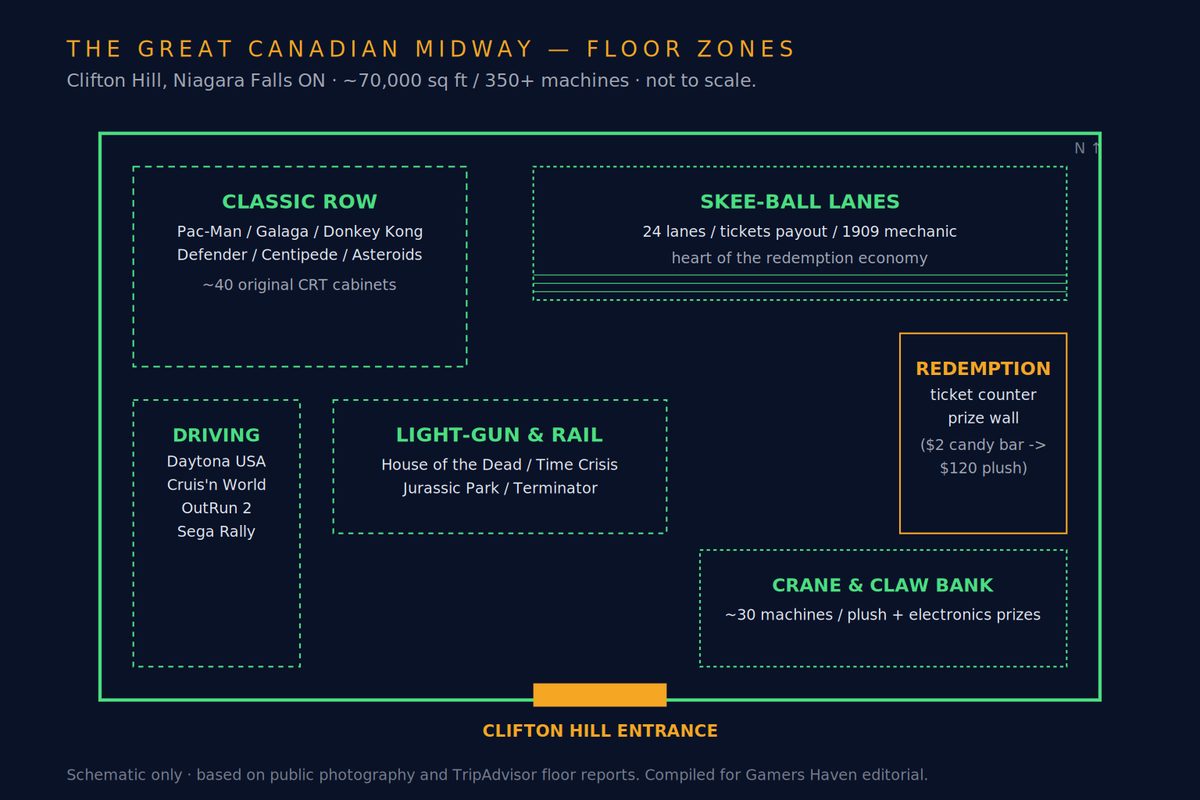
Where the floor money actually sits.
Floor schematic of the Great Canadian Midway: Classic Row in the north-west, Skee-Ball lanes anchoring the north wall, redemption counter pinned to the east corner where ticket throughput is densest, light-gun rail along the south-centre and the driving cabinets pulled to their own bay on the south-west.
Great Canadian Midway · floor zones, not to scale.
Across Gamers Haven
Related Reading
Konami's Decline — the pachinko pivot is, structurally, the inverse story to the surviving Canadian arcade: a publisher that walked away from console games to chase venue-based ones in a different country.
Don't Wait for Half-Life 3 — Valve's response to the format-survival question was to find the platform niche (VR) where the franchise's original value still held. Same pattern.
Random Encounters in RPGs — another design idea that survived in one niche after the mainstream walked away.
The arcade-games beat is the part of Gamers Haven editorial that takes the venue type seriously as a survival case study. The dominant industry narrative — that the arcade format died in the mid-1990s when home consoles closed the technology gap — is largely true for the United States and largely false for Canada. The category coverage here focuses on the operators who kept the original commercial model running through the collapse decade, the specific economic and geographic conditions that made survival possible, and the way the surviving venues curate their floor for the audience that still walks through the door rather than for the audience the format used to serve.
The longer reading lives in the full feature. The category landing is intentionally a single-entry hub for now, with adjacent material elsewhere on the site for context — Konami's pachinko pivot is the inverse story (catalog extraction rather than venue survival), Valve's VR pivot is a structurally similar reading (format moves to where its value still holds), and the random-encounter retrospective is a different example of a design idea that survived in one niche after the mainstream walked away. The intent is to grow this beat with additional pieces over time — Japanese arcade culture is the obvious next subject — but each new entry will be a full-length editorial argument rather than a list-driven catalog.
Quick Questions
Category FAQ
What kind of arcade coverage does Gamers Haven publish?
Editorial reading rather than buyer's-guide listings. The category focuses on the venue economics of surviving commercial arcades, the curatorial choices that distinguish working arcades from barcades and museums, and the long arc of how the quarter-eater format moved from technological niche to venue category.
Why focus on the Canadian arcade scene specifically?
Because Canadian arcades — particularly the Niagara Falls and Quebec tourist corridors — are the strongest surviving working-arcade category in North America. The American market mostly transitioned to barcades or family entertainment centers; the Canadian operators kept the original commercial model. The Great Canadian Midway is the largest surviving example.
Does Gamers Haven cover vintage cabinet preservation?
Adjacently. The category leans toward working commercial venues rather than vintage-cabinet museums or collector culture, but the cabinet-preservation question is part of the broader survival reading. Sites like Funspot in New Hampshire and the various Galloping Ghost-style flat-rate vintage venues are mentioned where they intersect with the working-arcade story.
Is the category limited to North American arcades?
For now, yes — the editorial reading is anchored in the North American survival arc. Japanese arcade culture (Taito Station, Round 1 in its original form, the various Akihabara venues) is the global benchmark and would warrant its own dedicated coverage in a future expansion of this category.
How are barcades treated in the category?
As an adjacent category. Barcades are a legitimate evolution of the venue type but operate on a different economic model (alcohol sales rather than coin drop), curate for nostalgia rather than current commercial catalog, and serve a different audience. The Gamers Haven reading distinguishes them clearly from working commercial arcades like the Midway.