Konami Is Still the Worst Gaming Company — and It Was a Decision, Not a Decline
Silent Hill, Castlevania, Contra, Metal Gear: Konami spent a decade systematically retiring its first-party identity in favor of pachinko machines and mobile titles. A reading of why it happened, what it actually cost, and why "decline" is the wrong word for what was, in fact, a corporate strategy.
For roughly thirty years, Konami was a top-tier console publisher. The catalog reads like a list of foundational works: Metal Gear Solid, Silent Hill, Castlevania, Contra, Suikoden, Pro Evolution Soccer, Dance Dance Revolution, Frogger, Gradius, Bomberman. The Konami Code itself — up, up, down, down, left, right, left, right, B, A — became the medium's most quoted cheat code, referenced in everything from Disney's Wreck-It Ralph to non-Konami games like Half-Life 2. Konami's name on a cartridge in 1991 meant "this will be good."
By 2016, the same name had become a punchline. Hideo Kojima had been publicly humiliated and pushed out. The most anticipated horror project of the decade — Silent Hills with Kojima, Guillermo del Toro and Norman Reedus — had been cancelled and its playable teaser P.T. deliberately delisted. Castlevania had been frozen mid-saga. The remake of Metal Gear Solid 3 had been announced not as a console title but as a pachinko machine. The catalog was being managed for licensing income rather than developed for the audience that built it.
The standard reading is that this was a decline — a once-great company falling apart through mismanagement. The more accurate reading is that it was a decision. Konami's leadership made a coherent business choice in the early 2010s to deprioritize console publishing in favor of pachinko, slot machines, mobile gaming, and gym/health-services revenue. Everything that followed flowed from that strategic bet. The reason the public reaction was so visceral is that Konami did not announce the bet — it executed it franchise by franchise, while continuing to take fan attention on the strength of a catalog it had quietly stopped feeding.
What Konami Actually Stopped Making
Silent Hill
Konami's horror franchise produced four canonical titles between 1999 and 2004 — the original Silent Hill, the universally praised Silent Hill 2, the divisive Silent Hill 3, and Silent Hill 4: The Room (which began life as a non-franchise project and was rebadged late in development). After 2004, Konami outsourced the franchise to a series of Western studios: Origins (Climax Studios), Homecoming (Double Helix), Shattered Memories (Climax again, the strongest of the outsourced entries), Downpour (Vatra Games), Book of Memories (WayForward, a Vita-only dungeon crawler that effectively ended the franchise).
In 2014, Kojima Productions and Guillermo del Toro announced Silent Hills, fronted by a free playable teaser titled P.T. on the PlayStation Store. P.T. was, by consensus, the strongest horror experience released that decade. In April 2015 the project was cancelled and Konami removed P.T. from the PlayStation Store, ensuring that any console that had not pre-downloaded the file could never run it again. The combination — cancellation plus deliberate de-listing — was widely read as a signal that Konami was not just abandoning the franchise but actively suppressing its strongest recent statement.
The post-script: in October 2024, Bloober Team's Silent Hill 2 remake released to strong reviews and commercial success. Konami's return to the franchise was a vindication of audience demand and an admission that the original 2015 cancellation was, in retrospect, a strategic error. It took nearly a decade.
Castlevania
Castlevania's story is structurally similar but more complete. The franchise had run continuously since 1986 — NES, SNES, Game Boy, PlayStation — and culminated in the 1999 setting of Castlevania: Symphony of the Night (1997, set in 1797). Following Symphony, an informal structure emerged: handheld titles ran the "Metroidvania" formula, while console titles continued the timeline toward a climactic Dracula confrontation in 1999.
The "Sorrow" duology (Aria of Sorrow 2003, Dawn of Sorrow 2005) functioned as an epilogue — the canonical defeat of Dracula has already happened, and the games concern a 21st-century reincarnation attempt. The franchise was, at that point, one console game away from being complete: the climactic 1999 confrontation had been built up across two decades and never been depicted.
Instead, in 2010, Konami released Castlevania: Lords of Shadow — a complete reboot, made by Spanish studio MercurySteam under Kojima Productions oversight. The reboot adopted a God of War-style combat system and abandoned the original chronology entirely. Two sequels followed (Mirror of Fate 2013, Lords of Shadow 2 2014); neither was well-received. The franchise has been dormant in original game form since 2014, though Netflix's animated Castlevania (2017-2021) and Castlevania: Nocturne (2023-) have kept the IP visible.
The decision to reboot rather than finish the legacy continuity is the cleanest example of Konami's pattern: rather than commission the one console game that would complete a beloved story arc, the company chose to abandon the arc and pivot to a structurally different product that ultimately failed to build a new audience.
Metal Gear Solid
The Kojima firing was the loudest, but the institutional pattern was the same. Metal Gear Solid V: The Phantom Pain (2015) was developed over five years on a from-scratch engine, the Fox Engine, designed to support a long-running annual sequel structure modeled on Call of Duty. A second studio, Kojima Productions Los Angeles, was established explicitly to alternate development cycles with the Tokyo team.
By mid-2015 Konami had publicly removed Kojima's name from the MGSV cover art, terminated his employment under a non-disclosure-style separation, restricted his ability to make public appearances, and explicitly barred him from attending The Game Awards 2015 to receive the prize MGSV had won. The Los Angeles studio was dissolved. The Fox Engine, designed for franchise reuse, was effectively benched.
What followed was instructive. Metal Gear Survive (2018), the first post-Kojima entry, was a co-op zombie survival reskin of MGSV's base systems set in an alternate universe. It launched to dismal reviews (Metacritic 64) and almost no audience. The remake of Metal Gear Solid 3, announced in 2016 as a pachinko machine, became the franchise's only meaningful release for half a decade.
The reversal came late: in 2023 Konami announced the Metal Gear Solid Master Collection Vol. 1, and in August 2024 a faithful Unreal-Engine remake of MGS3 titled Metal Gear Solid Delta was confirmed. The same pattern as Silent Hill — abandonment, audience erosion, eventual reversal — but executed over nearly a decade of franchise dormancy.
Contra and the Run-and-Gun Catalog
Contra, the seminal run-and-gun franchise, has had effectively no flagship release since Contra 4 (2007) on the DS. The 2019 Contra: Rogue Corps launched to a 49 Metacritic score; the 2024 Contra: Operation Galuga from WayForward landed better but is a remix rather than a forward step. Suikoden, the cult JRPG, has had no mainline entry since 2006. The earlier-Konami staples — Frogger, Bomberman, Gradius — appear primarily in collection re-releases and arcade-throwback compilations.
Why Pachinko Was the Bet

The strategic logic, viewed from inside Konami in the early 2010s, was straightforward. Pachinko and pachislot machines in Japan represented a ~¥20 trillion industry (roughly USD $180-200B at the time) — larger than the entire global video game market. Pachinko cabinets have unit margins that console games cannot match: each machine retails for ¥300,000-500,000, license costs to anime/game IP are significant, and parlor operators replace machines on a 3-5 year cycle. The IP libraries that Konami had built across thirty years of console publishing were extremely valuable as licensing surfaces for pachinko.
Konami's Metal Gear Solid 3 Snake Eater Pachislot (2016) was the proof-of-concept. The machine reused MGS3's cinematic cutscenes, ported the audio, and bundled the franchise's prestige into a gambling product aimed at the Japanese domestic market. The development cost was a fraction of a console sequel; the per-unit margin was substantially higher.
From a purely financial perspective, the bet worked. Konami's net income grew steadily through the late 2010s; the company's market position in Japan strengthened; the gym/sports-club division (Konami Sports) added a third revenue leg. The corporate problem was not financial — it was reputational. The audience that had built Konami's prestige did not buy pachinko machines, and felt, accurately, that they had been used as marketing input to a product not made for them.
The Other Konami Story — Working Conditions
Adjacent to the franchise question is the reporting on Konami's internal culture. The most-cited account is Nikkei's August 2015 investigation, which described practices including: badge-scanning at the cafeteria to track employees' lunch durations; security cameras directed at developers' workstations; the reassignment of unproductive developers to the pachinko assembly line as a kind of demotion; the relocation of programmers and designers to security-guard or janitorial duties; and an enforced silence around the Kojima firing that included staff being instructed not to acknowledge his existence.
The Nikkei reporting has been substantially independently corroborated by ex-Konami staff over the subsequent decade. The picture is of a company that treated its creative workforce as fungible labor and saw the long franchise-development cycles of console gaming as a productivity problem rather than a creative discipline.
This part of the story matters because it explains the catalog decisions. A company that genuinely valued the work of its developers does not put designers on the pachinko line. The reassignment policy was a signal of where Konami's institutional priorities had moved — and the catalog reflects that priority shift.
The Useful Contrast
Konami's pachinko pivot looks different next to the strategies its peers chose. Capcom (which faced a similar mid-2010s creative slump) responded by doubling down on internal RE Engine development and rebuilding Resident Evil, Devil May Cry, Monster Hunter and Street Fighter on the same technical and creative substrate. The result has been one of the strongest mid-2020s catalog runs in the industry.
Square Enix kept Final Fantasy in continuous production and accepted the cost of Final Fantasy XV's troubled development as the price of admission. Nintendo, faced with the question of how to extend its catalog into a new hardware era, built Breath of the Wild and effectively reset its biggest franchise on its own terms — a creative bet rather than a financial one. (The reading of that bet is the work done in the Zelda timeline piece.) Valve, faced with a similar question, simply stopped speaking about Half-Life 3 — which, in retrospect, was a more honest answer than Konami's franchise dormancy.
The contrast clarifies what Konami chose. The pachinko pivot was not the only possible response to the mid-2010s console market. It was the response that maximized short-run margin while accepting the cost of catalog atrophy. Calling that "decline" elides the agency in the choice.
The Reversal That Came Too Late
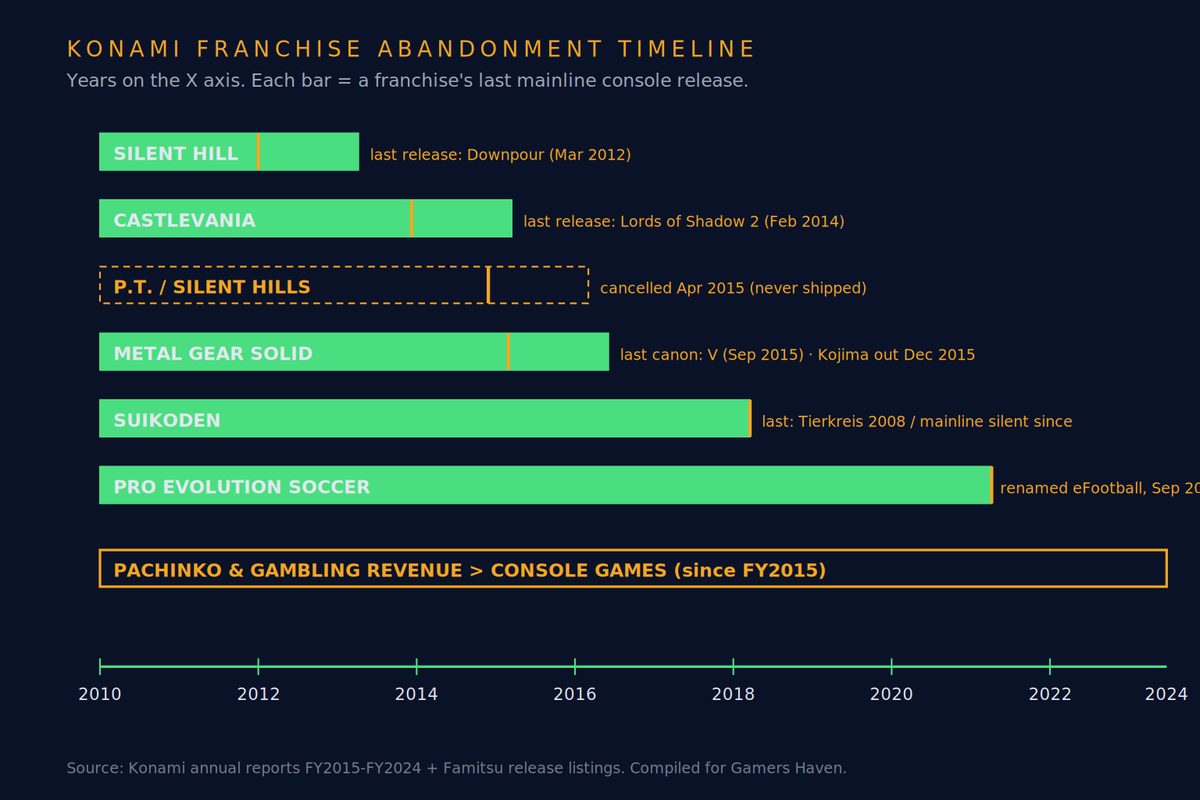
Beginning in 2022, Konami began signalling a return to console publishing. The signals included: the eFootball rebrand and free-to-play pivot (2021); the Castlevania Anniversary Collection (2019) and Castlevania Advance Collection (2021); the Yu-Gi-Oh! Master Duel success (2022); the announcement of the Silent Hill 2 remake (2022, released October 2024); the Metal Gear Solid Master Collection Vol. 1 (October 2023); the Metal Gear Solid Delta: Snake Eater remake announcement (May 2023); and Bloober Team's confirmed work on additional Silent Hill projects.
The reversal is real but partial. Konami is rebuilding the catalog through external partnerships (Bloober Team for Silent Hill, Virtuos for Metal Gear remakes) rather than reinvesting in first-party development. The creative bench that produced the original 1990s-2000s catalog is largely gone. The pattern of relicensing to external studios is, in effect, a different kind of catalog management — one that monetizes the IP without committing to a development organization that can extend it.
The 2024 Silent Hill 2 remake's commercial success vindicated audience demand, but it also clarified what Konami had given up. The remake works because Team Silent's original 2001 design holds. The question Konami has not yet answered is whether it can produce new prestige work, on first-party resources, that will outlive the catalog.
Why the Konami Story Still Matters
The Konami case is the modern industry's clearest example of what happens when a publisher's incentives diverge from its catalog's audience. Most publisher reversals are partial; Konami's was structural. For a decade, the company explicitly chose to monetize prestige IP through a different product line, in a different country, for a different audience.
The case is also a useful index of how the industry talks about catalog stewardship. Franchises like Silent Hill and Castlevania were treated, in their original development, as the work of identifiable creative teams (Team Silent; Koji Igarashi's team). When those teams were dissolved, the franchises did not "decline" in some natural sense — they were continued by other teams who had inherited the IP without the institutional knowledge that built it. That is the actual mechanism behind a publisher's catalog losing its identity. Konami is the cleanest example because it happened to multiple franchises, in the same window, under the same leadership.
The closing reading: "Konami is the worst gaming company" was the standard 2016 take and it was correct in spirit but imprecise. Konami did not become bad by mistake. Konami's leadership made a strategic decision to extract value from the catalog rather than continue building it. That decision held for roughly nine years before audience demand and external partner interest pushed Konami partway back into the original business. The cost of those nine years was a generation of cancelled, frozen, or outsourced franchise work that the catalog will not fully recover. The decision was rational. The decision was also, depending on the reader's point of view, a betrayal of the audience that built the company.
Frequently Asked Questions
When did Konami pivot to pachinko?
The strategic pivot consolidated in 2014-2016. The Silent Hills cancellation (April 2015), the Kojima removal (mid-2015), and the announcement of the MGS3 Snake Eater pachislot (2016) are the three public signals that mark the strategy as fully operational. The internal corporate decision is likely older — Konami's pachinko subsidiary had been growing since the early 2000s.
Why did Konami fire Hideo Kojima?
Officially, Konami has not stated the reason. The widely reported account is that Metal Gear Solid V's development was substantially over budget and over schedule, and that Konami's leadership wanted to redirect the studio toward the new corporate strategy of higher-margin, lower-cost mobile and pachinko products. Kojima's continued public profile after his departure (founding Kojima Productions with Sony funding, shipping Death Stranding 2019 and Death Stranding 2 2025) suggests the firing was an institutional rather than creative judgment.
What is P.T.?
P.T. ("Playable Teaser") was a free downloadable horror experience released on the PlayStation Store in August 2014. It was revealed at its conclusion to be the announcement for Silent Hills, a collaboration between Kojima Productions, Guillermo del Toro and Norman Reedus. Silent Hills was cancelled in April 2015 and P.T. was removed from the PlayStation Store on April 29, 2015. The file cannot be re-downloaded; copies persist only on consoles that pre-downloaded it.
Why was P.T. removed?
Konami did not provide a public explanation. The widely accepted reading is that the company wanted to prevent P.T. from continuing to generate audience demand for a cancelled project — and from continuing to demonstrate the kind of high-prestige horror work the company had decided not to pursue.
Has Konami released any new console games since 2016?
Yes, but selectively. Pro Evolution Soccer (rebranded to eFootball in 2021) continued. Metal Gear Survive (2018) released to poor reception. Yu-Gi-Oh! Master Duel (2022) was a mobile-first success. Castlevania Advance Collection (2021) and Anniversary Collection (2019) were catalog re-releases. The first major new console first-party release in nearly a decade is the 2024 Silent Hill 2 remake, developed externally by Bloober Team.
Further Reading on Gamers Haven
- Don't Wait for Half-Life 3 — Valve's silence as catalog strategy, in contrast to Konami's pachinko strategy.
- The Zelda Timeline Still Makes No Sense — what happens when a publisher tries to retrofit a catalog rather than extend it.
- Is Far Cry Primal Part of the UbiVerse? — Ubisoft's opposite problem: too much retrofitted continuity, not too little.
- Arcade Adventures at the Great Canadian Midway — the arcade-era catalog that several of Konami's franchises were originally built for.