The Zelda Timeline Still Makes No Sense — and Breath of the Wild Proves It
Hyrule Historia tried to fix the chronology in 2011. Breath of the Wild broke it again in 2017. Tears of the Kingdom and Echoes of Wisdom have since finished the job. A reading of why the official timeline was never a coherent organising frame — and what to read in its place.
Fans like things to connect. The instinct that pulls together unrelated franchises into a shared canon — Tarantino's films, every Pixar movie, the famous Tommy Westphall theory that anchors most American television in a single child's mind — is the same instinct that produced the Zelda timeline. Three decades of nominally standalone games featuring a green-clad swordsman, a princess named Zelda, a kingdom called Hyrule and a recurring villain named Ganon were stitched into a master chronology that, in theory, accounts for every release from The Legend of Zelda (1986) onward.
That master chronology is the one Nintendo published in Hyrule Historia, a lavishly designed companion volume released in Japan in December 2011 and in English by Dark Horse Books in January 2013. The book includes a fold-out timeline that places every Zelda game into one of five eras, with one critical fork at Ocarina of Time producing three parallel branches. It is the closest thing to an official Zelda canon, endorsed by series director Eiji Aonuma.
It also does not work. It did not work in 2011, it strained badly under Breath of the Wild in 2017, and as of Tears of the Kingdom in 2023 and Echoes of Wisdom in 2024, it has effectively been retired without ever being formally retracted. The argument below is that the timeline was never the right reading frame for the series in the first place, and that the games themselves — including the newest ones — quietly agree.
What Hyrule Historia Actually Says
Before getting to the contradictions, it is worth being precise about what the book proposes. Hyrule Historia organises the franchise around five named eras, two of which are pre-fork and three of which are post-fork branches:
- The Era of Skyloft (also called the Era of the Goddess Hylia) — anchored by Skyward Sword (2011), framed as a creation story.
- The Era of Myth and Era of Chaos — bridge eras containing Minish Cap (2004) and Four Swords (2002).
- The Era of the Hero of Time — the point where the timeline forks, anchored by Ocarina of Time (1998) and Majora's Mask (2000).
- The Adult Era branch — Wind Waker (2002), Phantom Hourglass (2007), Spirit Tracks (2009).
- The Child Era branch — Twilight Princess (2006), Four Swords Adventures (2004).
- The Era of Decline branch — the original Legend of Zelda (1986), Zelda II: The Adventure of Link (1987), A Link to the Past (1991), and Link's Awakening (1993).
The fork itself is structurally strange. The book argues that, at the climax of Ocarina of Time, three things happen simultaneously: an Adult-Era continues in the world where Ganon has been sealed (the Wind Waker branch); a Child-Era continues in the world where Link returns to his childhood and warns Zelda (the Twilight Princess branch); and an Era of Decline begins in the world where Link loses the fight with Ganon. The third branch is widely understood as the canonical Game Over screen — the timeline that flows from the player's failure.
That structural choice is the part of Hyrule Historia that became infamous. The official chronology treats a failure state as a branch of canon, which is unusual enough to be charming, but it also means the three timelines were always more of an editorial fix than a designed continuity. Read carefully, the Game Over branch is a way to make the 1986 original retroactively fit a 1998 game.
Where Breath of the Wild Lands — and Why It Doesn't
Breath of the Wild arrived in March 2017 and immediately presented a placement problem. Nintendo's own statements at the time placed it "at the end of every timeline" — a designed ambiguity that, in practice, means it sits at the end of no coherent timeline. Series producer Eiji Aonuma told interviewers that the team approached the placement question deliberately loosely.
The contradictions are easy to enumerate once the game is read against the published chronology:
- The game's history dialogue places its events "10,000 years after" a Calamity Ganon eruption, with the most recent Calamity occurring 100 years before the opening. Ocarina of Time's Ganondorf is the first appearance of Ganon as a coherent antagonist, so a 10,000-year gap pushes the events out of any branch that begins at the Hero-of-Time fork.
- The Rito appear in Breath of the Wild. Per the published lore, the Rito are an evolved post-Hylian race that only exists in the Adult Branch — they replace the Zora in Wind Waker's ocean-flooded Hyrule. But Breath of the Wild also features Zora, which the Adult Branch supposedly does not have.
- Topography. The Adult Branch flooded Hyrule into the Great Sea and renamed the landmass "New Hyrule". Breath of the Wild shows old Hyrule (Death Mountain, the Faron region, the Lost Woods, Hyrule Castle) intact and unflooded.
- The Sheikah technology stratum (Guardians, Sheikah Towers, the Slate). It has no antecedent in any prior game. The closest reading is that the entire Sheikah technological civilisation existed and collapsed before the Era of Skyloft, but Hyrule Historia has no slot for that.
The cleanest reading is that Breath of the Wild is set so far after its own civilisation's collapse that none of the prior placement signals are recoverable. That works as fiction — the game is partly about reading ruins — but it also leaves the published timeline holding nothing. If a game is placed past the legibility horizon of every branch, the branches stopped doing the work of organising the series.
Tears of the Kingdom Doubles Down
Tears of the Kingdom shipped in May 2023 and was explicit about its setting: a direct sequel to Breath of the Wild, set "a few years later", with a flashback frame that depicts the founding of Hyrule by a Zonai-descended royal couple named Rauru and Sonia. The Zonai are framed as the originating civilisation — older than the Sheikah, older than the Triforce events of Skyward Sword.
This is a serious problem for the published timeline. The Hyrule Historia chronology begins with Skyward Sword's Era of Skyloft as a founding myth. The Zonai foundation story in Tears of the Kingdom sits chronologically before, after, or instead of Skyloft, depending on how one reads it — but it cannot sit inside the existing chronology without rewriting the founding-myth status of Skyward Sword.
Aonuma, in the Tears of the Kingdom press cycle, told Famitsu that the development team treated the timeline as a guidance tool rather than a fixed canon. The phrasing is careful but the meaning is clear: the chronology is a soft constraint that the writing room overrides as needed. That is not how a true canon behaves.
Echoes of Wisdom and the Princess Pivot
Echoes of Wisdom arrived in September 2024 and was the first mainline Zelda game in which the playable protagonist is Princess Zelda rather than Link. The game's setting is recognisably the Hyrule of A Link to the Past / A Link Between Worlds — that is, the Decline Branch — but with structural elements (Tri Rod summoning, dimensional rifts) that have no precedent in any branch.
The "echoes" themselves — the ability to summon copies of objects and creatures the protagonist has previously seen — are a mechanical idea borrowed from Tears of the Kingdom's Ultrahand and Recall. That mechanical bridge implies a development-time relationship between the two games that the chronology does not formally describe. Either the Decline Branch absorbed the Zonai technology that originated in the unbranched Tears of the Kingdom continuity, or the branches were never meaningfully separate in the writers' minds.
The Mechanical Reason It Cannot Work
The structural reason the Zelda timeline never held together is that the games were not designed as a continuity puzzle. The pattern that the series has actually followed since 1986 — and that Aonuma has confirmed in multiple interviews — is much simpler:
- Each new mainline game starts with a target mechanic (top-down dungeons, a hookshot, sailing, motion controls, climbing-and-cooking, fusion).
- The story is built around that mechanic to give it a stage.
- Recurring elements — Link, Zelda, Hyrule, Ganon, the Triforce — are deployed as fixtures of a cyclic myth, not as characters with continuous biographies.
Read this way, "the Zelda timeline" is a category error. Each game is a retelling of the same myth in a different historical period of a fictional kingdom that periodically resets. The recurring "Link", "Zelda" and "Ganon" are roles, like the recurring Doctor in Doctor Who, not single characters with travel itineraries. Hyrule Historia's project — to make every retelling literally true at once — was always going to require Game Over branches.
Three Alternative Readings That Actually Work
1. The Cyclic Reading
Hyrule is a kingdom that periodically collapses and reforms. Each mainline game shows one collapse-and-reformation cycle. Link is the name the kingdom gives to the swordsman who appears each time. This is consistent with the recurring Demise's curse arc explicitly stated in Skyward Sword: "an incarnation of my hatred ... shall ever follow your kind".
2. The Mythological Reading
Each Zelda game is a separate retelling of the same Hyrulean cycle, told by different in-world storytellers. None of them is "what really happened" — they are all variants of a shared story, the way Genji Monogatari exists in dozens of textually-distinct manuscripts that all count as the work. This reading also has an in-game anchor: the opening narration of The Wind Waker explicitly frames the series as "a legend told by the people of that land".
3. The Hard-Reset Reading
Continuity is on a strict per-game basis. Recurring elements are franchise furniture and nothing more. This is the simplest reading and the one Miyamoto and Aonuma have most consistently endorsed in interviews from 1991 onward. It also happens to match the way the games actually behave.
What "Canon" Means for a Series That Doesn't Need It
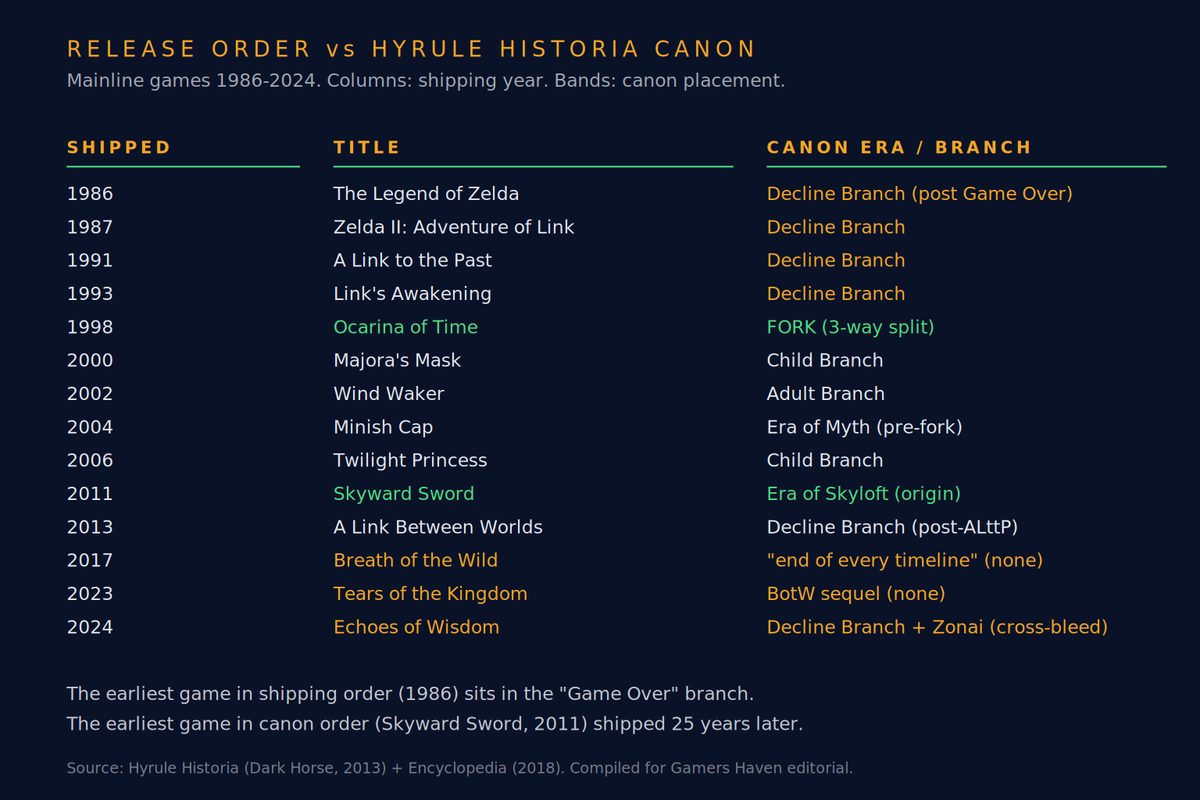
The Zelda timeline was a 2011 retrofit. It was always going to be approximate. The honest version of the chronology is something like: Skyward Sword is a founding myth; Ocarina of Time is the central archetype; Wind Waker and Twilight Princess are tonal variants; the original Legend of Zelda sits in a comparatively distant Decline. The Game Over branch is a bookkeeping fix for the fact that the 1986 game has Ganon already loose, which means the standard heroic Hero-of-Time ending cannot have occurred.
That is not a coherent chronology. It is a family tree of related but mutually independent works that share a vocabulary. The same is true of Final Fantasy, which Square Enix has never attempted to canon-merge, and the same is true of every Doctor Who incarnation. The interesting question is not "where does Breath of the Wild fit on the timeline" but "what does each Zelda game say about its own historical moment in gaming" — a question the series itself rewards, given how clearly each instalment is built around its hardware generation.
This is also why the timeline debate has slowed since 2017. Hardcore lore communities still post placement theories, but Nintendo has effectively stopped commenting on the chronology, and the editorial position of Gamers Haven is that they were right to stop. The chronology argument was a fan-service mistake. The games never needed it, and they have spent the last decade quietly stepping away from it.
Related Reading on Continuity Puzzles in Games
The shared-universe instinct shows up across the medium. Gamers Haven's reading of Ubisoft's "UbiVerse" makes a structurally similar argument about Far Cry Primal: it has been formally placed inside a shared continuity, but the connecting tissue is so thin that the placement is editorial rather than dramatic. The Valve corollary appears in the analysis of why Half-Life 3 was never coming, which makes the case that Valve's silence on the sequel is not a continuity problem so much as a decision to stop telling that particular story. The argument across all three is the same: shared-universe canons in gaming are mostly post-hoc reading, and the games rarely benefit from the retrofit.
Frequently Asked Questions
Is the Zelda timeline officially canon?
Hyrule Historia (2011 / English 2013) was endorsed by series director Eiji Aonuma, which makes it the closest thing to an official chronology. The 2018 Encyclopedia reaffirmed it. However, Aonuma has repeatedly described the timeline as a "guideline" rather than a fixed canon, and post-2017 games have ignored its constraints, so the practical canon status is soft.
Where does Breath of the Wild fit on the timeline?
Nowhere cleanly. Nintendo's stated position is that Breath of the Wild takes place "at the end of every timeline" — which means it doesn't belong to any single branch. Internal evidence (the Rito plus the Zora, old Hyrule's topography, 10,000-year gap from Calamity Ganon) contradicts every published branch.
What is the Decline Branch?
The Decline Branch is the timeline that flows from Link losing the climactic fight in Ocarina of Time. It is canonically the Game Over screen, and it contains the original Legend of Zelda (1986), Zelda II (1987), A Link to the Past (1991) and Link's Awakening (1993). Treating a failure state as canon is one of the timeline's strangest design choices.
How many Zelda timelines are there?
Per Hyrule Historia: three (Adult, Child, Decline) after the Hero of Time fork, plus two pre-fork eras (Skyloft and Myth). Five named eras, three post-fork branches.
Did Nintendo plan the Zelda timeline from the start?
No. Miyamoto has stated in multiple interviews going back to the 1990s that the games were designed standalone, and the chronology was retrofitted in the late 2000s for Hyrule Historia. The Game Over branch in particular is a structural fix to make the 1986 original consistent with later releases.
Further Reading on Gamers Haven
- Is Far Cry Primal Part of the UbiVerse? — a parallel argument about Ubisoft's shared-canon retrofit.
- Don't Wait for Half-Life 3 — why Valve's missing sequel is a continuity question that is no longer worth asking.
- Konami's Decline — what happens when a franchise custodian stops believing in its catalog.
- Artificial Intelligence and Minecraft — an adjacent reading on procedural systems and what counts as a "world" in a game.